
Punteggio di impatto
Footprint Score sui due contesti più rappresentativi.
Score Homepage
Impatto misurato sulla home page pubblica
- Tempo
- 52 ms
- Memoria
- 1.0 MB
- SQL
- +26
- Asset
- 0
- HTTP est.
- 0
Score Admin
Impatto misurato nell'amministrazione WordPress
Informazioni
404 to 301 is a redirect manager and 404 error monitor for WordPress. Create your own custom redirects with 301, 302 or 307 redirection, send every remaining 404 error to a page of your choosing, and keep a full log of the broken links visitors and search engines actually hit.
Broken links cost you traffic. A visitor who lands on a 404 page usually leaves, and Google eventually drops the URL from its index along with whatever link equity it had earned. This redirect manager fixes both halves of that problem. You get precise redirection rules for the URLs you know about, and 404 error logs that surface the ones you don’t.
Need more than redirects?
404 to 301 is free and every feature is included, with no license key and no upsell. If you also want full-site and .htaccess redirect rules, automatic 404 monitoring across large sites, Google Search Console crawl error data, and a complete SEO toolkit alongside your redirection, take a look at AIOSEO Pro.
Leggi tutto Mostra meno
Take control of your URLs from one redirect manager. Create as many custom redirects as you need and pick the redirect type per rule, so a permanent move uses a 301 redirect and a temporary campaign URL uses a 302 or 307 redirect.
Match URLs by exact path when you know the address, by prefix when a whole folder has moved, or by regular expression when you need a pattern. Prefix matching covers the wildcard redirect cases, where every URL under /old-shop/ should land on its counterpart under /shop/. Regex redirect rules handle the messy ones, like a query string that changed format or a date-based permalink structure you have retired.
Every redirect carries a hit counter and a last-hit timestamp, so you can see which rules are earning their keep and which are dead weight. Toggle a rule off without deleting it when you want to test, and manage the whole set from a table with search, filters, bulk actions and pagination.
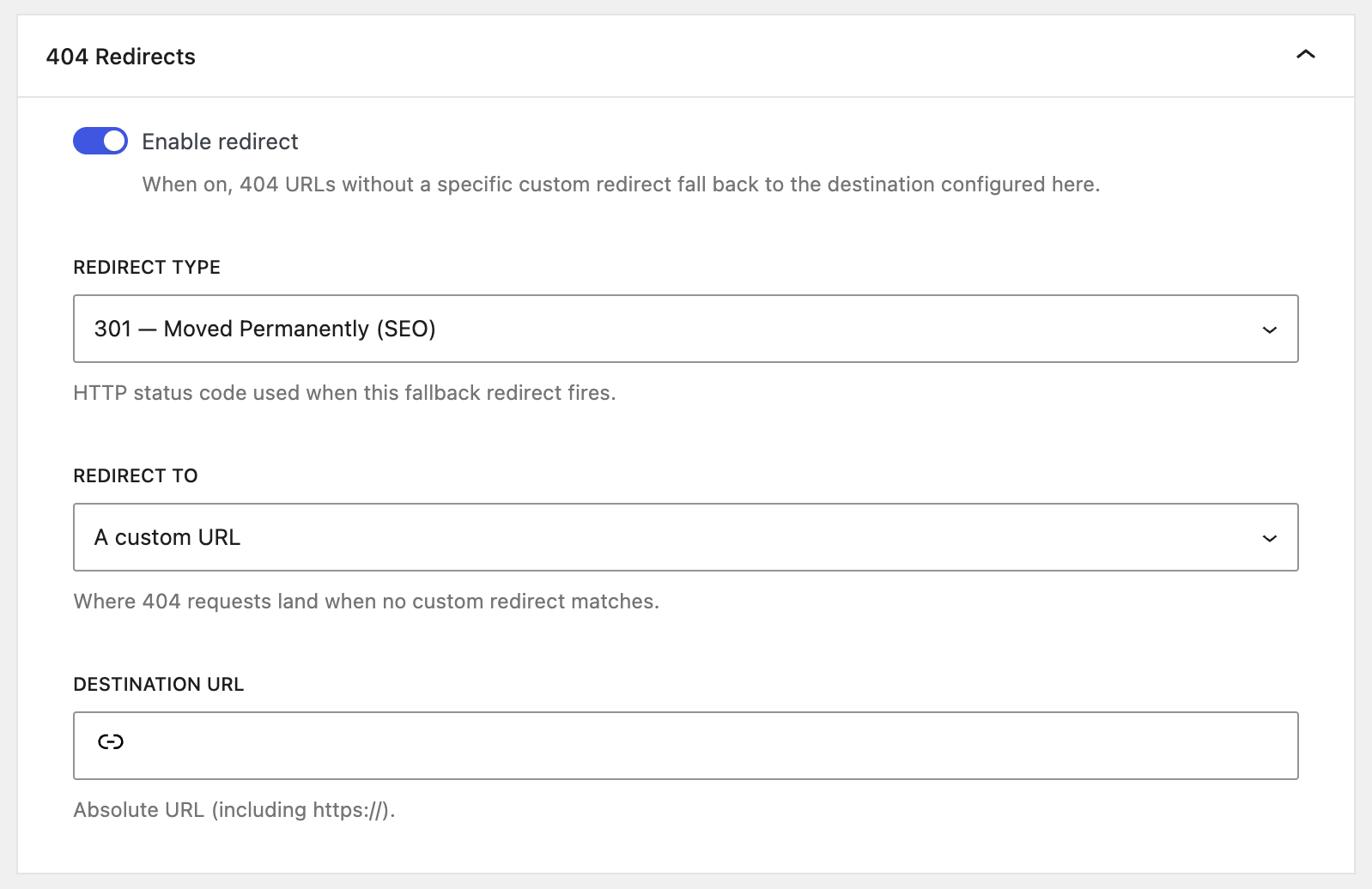
You will never catch every broken URL by hand. Set a global fallback and 404 to 301 redirects every leftover 404 error automatically, to your homepage, a specific page, or any URL you like, using the redirect type you choose.
That turns a dead end into a route back into your site. Visitors who would have bounced off a 404 page keep browsing, and search engines following an old inbound link reach real content instead of an error.
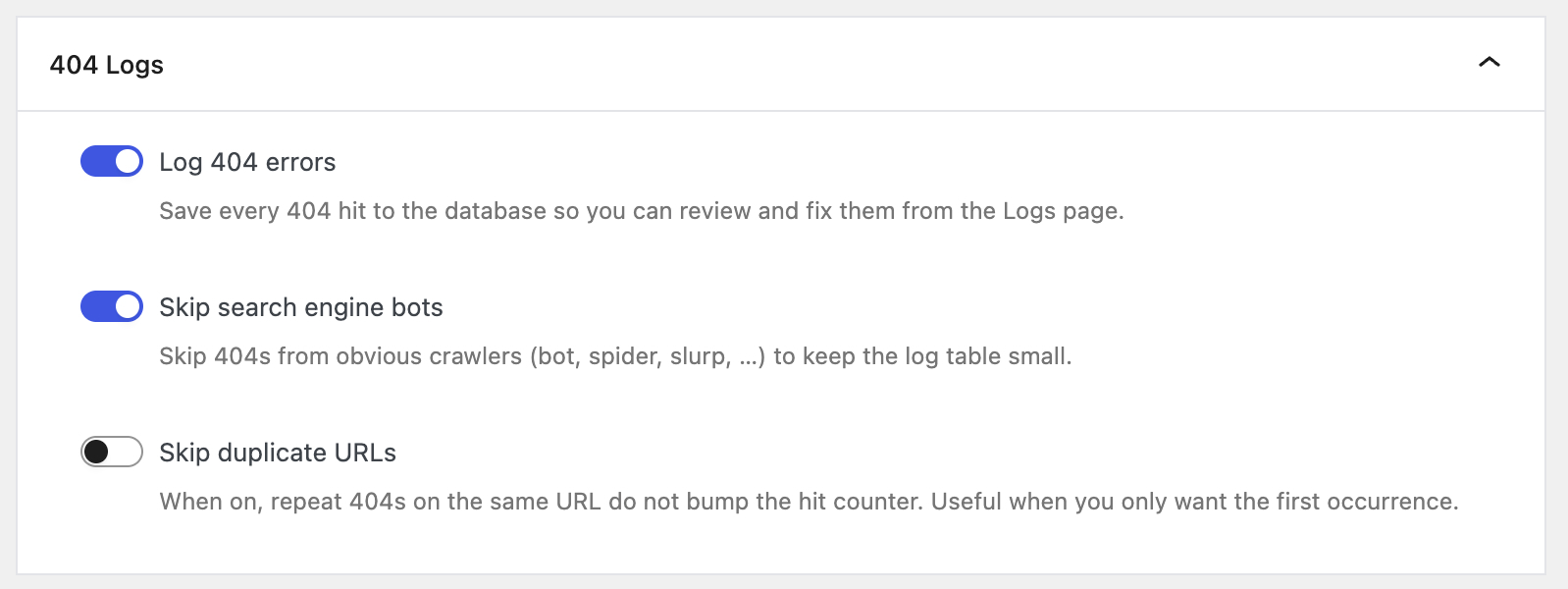
The 404 error logs tell you which links are breaking and where the traffic is coming from. Each entry records the requested URL, the referrer, the IP address, the user agent and the timestamp, so you can tell a mistyped address apart from a broken inbound link that deserves a redirect.
Busy broken URLs stay readable. Repeat hits are deduplicated into a single row with a hit count, so one popular dead link is one entry instead of thousands. Sort by hits and the URLs worth fixing rise to the top on their own.
Two filters do most of the triage for you. Filter by referrer source to separate the 404 errors your own pages are linking to, which are yours to fix in the content, from the ones arriving off other sites, which want a redirect. Filter by request type to split real page and post requests from missing files and assets, so a hotlinked image or a stale script does not sit in the same queue as a lost article.
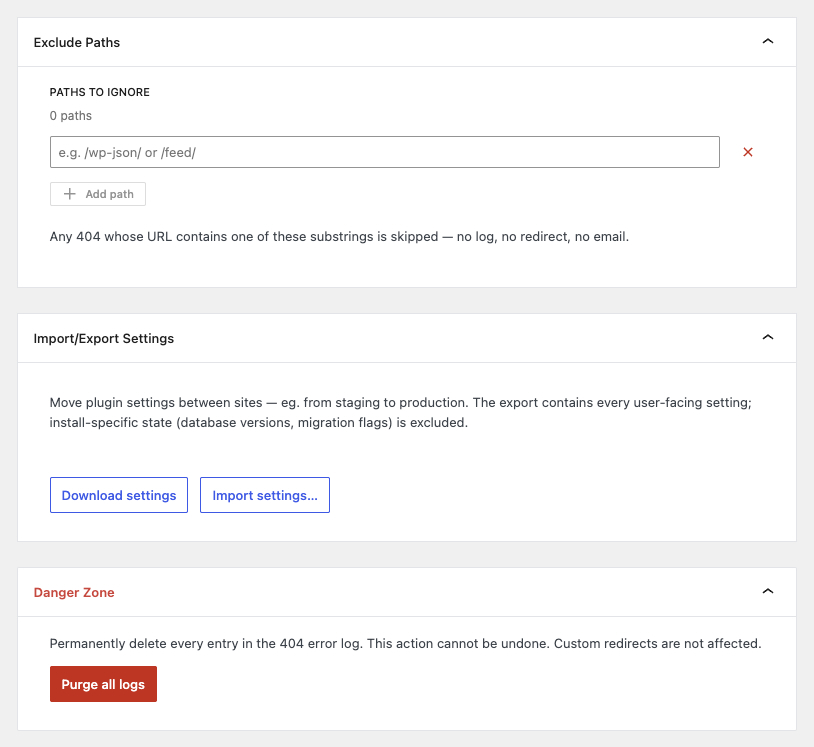
Each 404 error carries a status of open, ignored or fixed, so the log works as a queue rather than a pile. Filter by date range, search by URL, then turn any logged 404 into a redirect in a couple of clicks. Privacy is covered too: IP addresses can be masked, and paths you do not care about can be excluded from logging entirely.
Most 404 error monitoring fails for a boring reason. Nobody remembers to go and look. So the numbers come to you instead.
A Recent 404s widget on the WordPress dashboard lists your busiest broken URLs from the last 30 days, and the admin menu carries a count of the 404 errors still waiting on a decision, the same way WordPress flags pending updates. Summary cards above the log split the totals by status, so you can see what is still open against what you have already fixed or ignored. WordPress Site Health runs its own checks on your 404 monitoring setup and tells you when logging is switched off, when the log table has grown large enough to need pruning, or when another redirect plugin is installed alongside this one and the two could fight.
A site migration is where redirects earn their reputation. Change a permalink structure, move to a new domain, or retire a batch of old posts, and every inbound link and every indexed URL points somewhere that no longer exists.
Map the old URLs to the new ones with prefix or regex redirection and the link equity follows. For everything you miss, the 404 error logs act as a safety net: watch the log for a week after launch and you will see the URLs Google and your visitors are still asking for, then redirect them. Those are the same URLs that show up as crawl errors in Google Search Console, caught on your own site without waiting for the next crawl.
The same routine works long after launch. Link rot is constant, external sites link to pages you later rename, and a redirect manager plus 404 monitoring is how you keep finding those before they cost you rankings.
Catch broken links before your visitors do
404 to 301 handles the visitors who already hit a dead URL. To find the dead links still sitting in your content, install Broken Link Checker — it’s free, scans your posts, pages and comments for internal and external links that no longer resolve, and lets you fix or unlink them from one screen.
Renaming a post is the most common way to break your own URLs. Switch on slug change monitoring and 404 to 301 writes the redirect for you: rename a post or page, and the old permalink starts pointing at the new one before anyone hits a 404.
You also get control over the guessing WordPress does on its own. Core quietly tries to match an unknown URL to a similar post before this plugin ever sees the request, which hides real 404 errors from your logs and can send a visitor to the wrong article. Leave that behavior alone, block just the closest-post guesses, or block guessing altogether so every miss is logged and redirected by your rules instead.
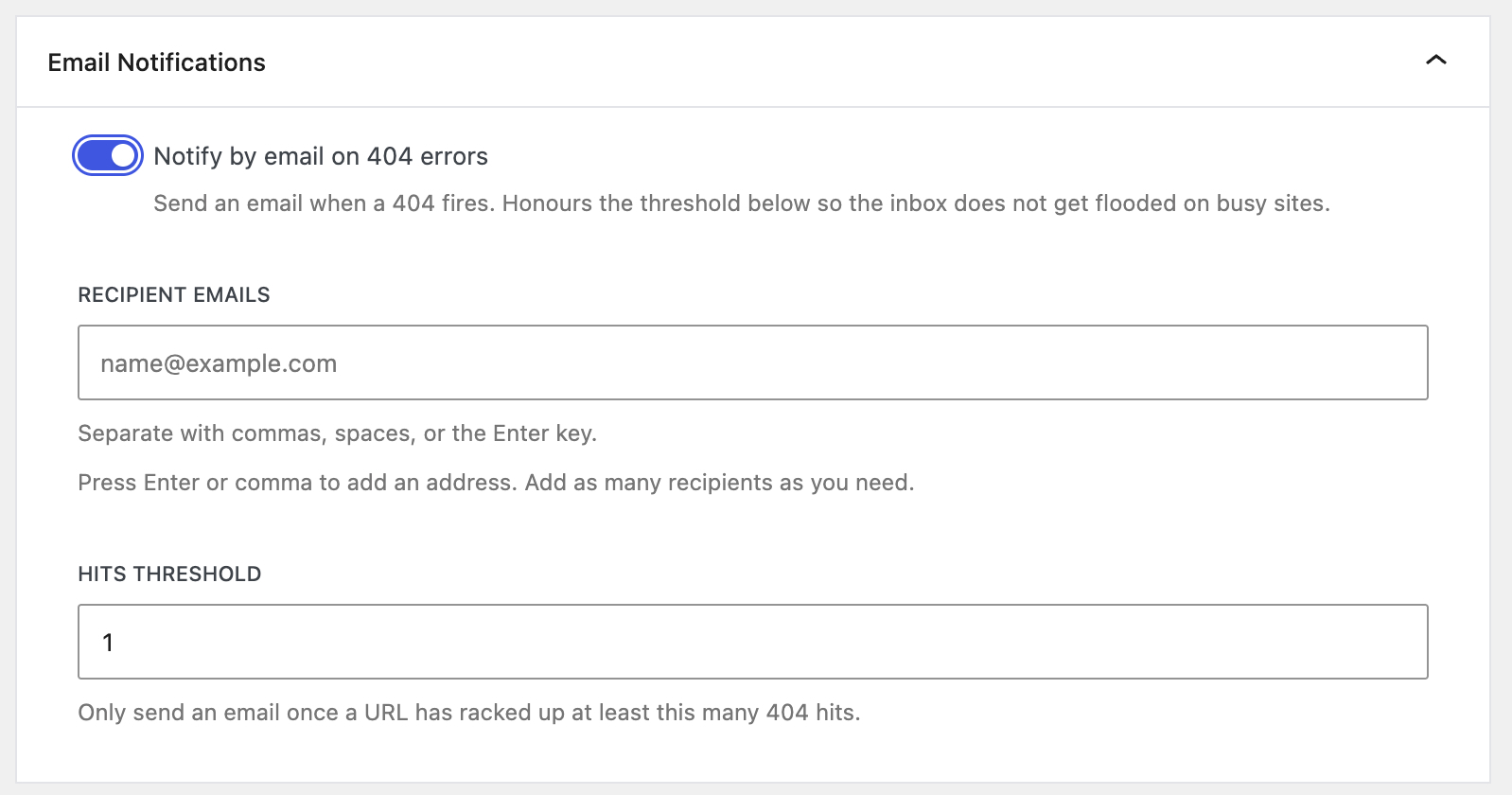
Nobody wants to live in the dashboard. Set a hit threshold and 404 to 301 sends an email alert when a broken link starts getting real traffic, so a busy site does not flood your inbox over a single stray request.
Switch on Email Reports and you also get a daily, weekly or monthly digest of your 404 activity with the log attached as a CSV. It is a five-second read that tells you whether anything needs attention.
Moving in from another redirect plugin does not mean retyping your rules. The redirects importer does a bulk redirect import from a CSV file, previews what it found and flags duplicates before anything is written, so you can see the damage before you commit to it.
Exports work the other way. Download the 404 error log as a CSV whenever you want it, filtered exactly the way the Logs page is showing, so a report you built with the referrer and date filters is the report you get. Your settings travel too: export them as JSON on one site and import them on the next, which turns a redirect and logging configuration you like into something you can roll out across every site you run.
Log cleanup keeps the table honest. Prune by age, by row count, or on a schedule, so a high-traffic site does not grow an unbounded 404 log, with a purge action for when you want to start over.
The plugin does its work only on a 404 request. Healthy page loads are never touched, so a redirect manager that sits on a busy site costs nothing on the pages that are working. Custom redirects resolve through a hashed, indexed lookup.
Developers get a REST API at /404-to-301/v1/ covering every admin operation, a full WP-CLI command set (wp 404-to-301 logs|redirects|settings), and a filterable action pipeline for hooking in custom logic. It is multisite compatible, and each site in the network keeps its own redirects and 404 error logs.
Everything the free redirect manager includes. For the wider SEO toolkit, see All in One SEO.
404 to 301 has been running on WordPress sites since 2014 and is active on more than 100,000 of them. It is maintained by the team behind All in One SEO, Broken Link Checker and more, used on over 3 million sites.
If you have been comparing redirect plugins you have probably looked at Redirection, 301 Redirects, Safe Redirect Manager and the redirect modules inside Yoast SEO Premium and Rank Math. They are capable tools and some of them are very widely used.
The difference here is scope. 404 to 301 does redirect management and 404 error logging, and it does not ask you to install an SEO suite to get them or pay for a license to unlock the importer. Every feature listed above is free, the log table keeps itself trimmed, and the plugin stays out of the request path on pages that are not 404ing.
404 to 301 is a product of All in One SEO. When writing about the plugin, please use the correct branding:
Schermate
Anteprime fornite dall'autore su wordpress.org.

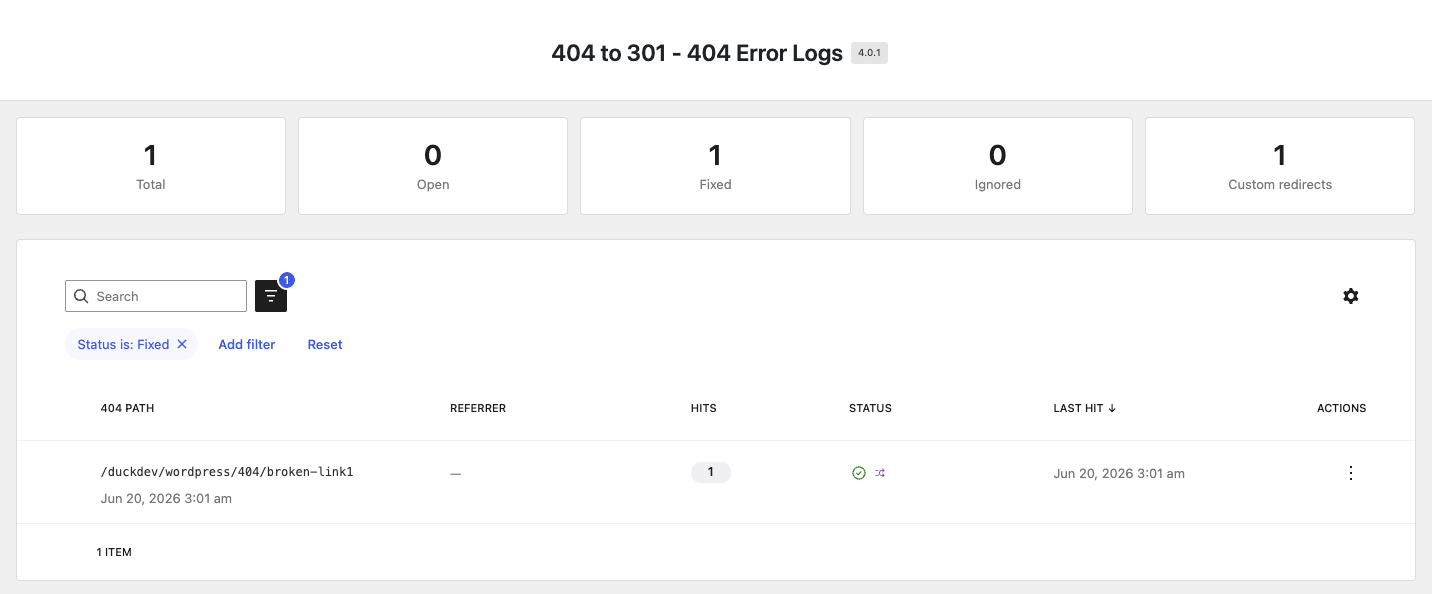
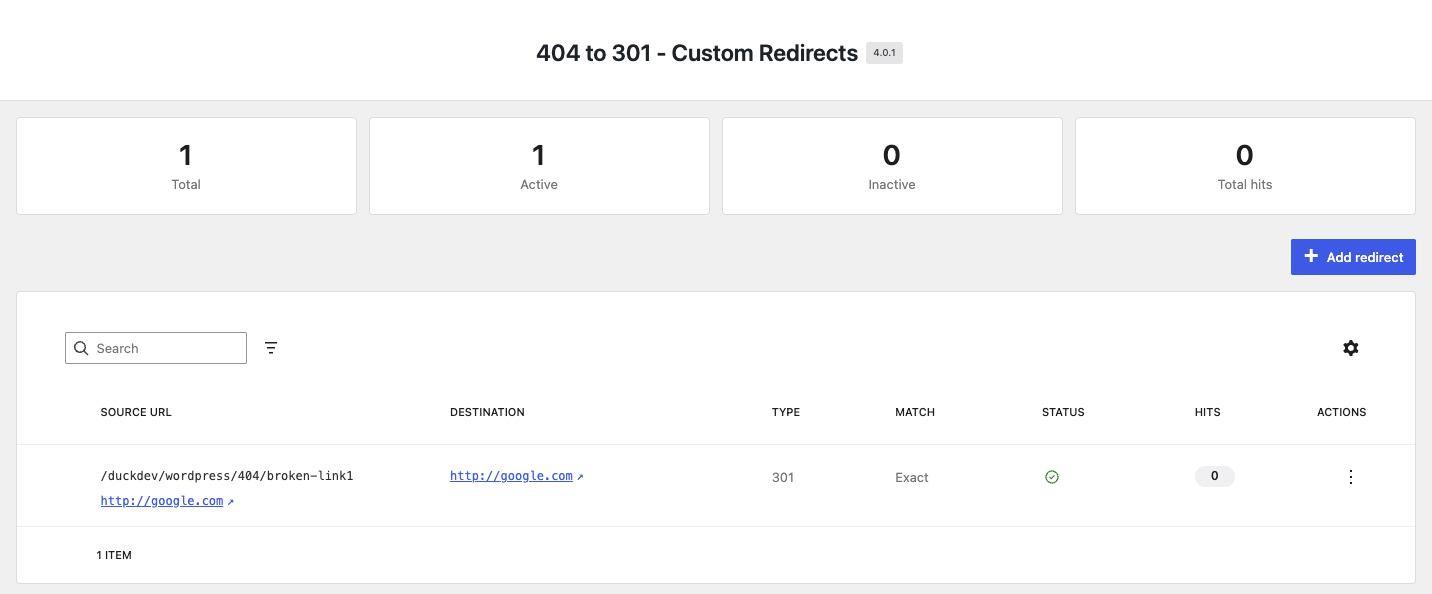
Storico per versione
Mostra il dettaglio per versione (1 versioni)
Storico per versione
Mostra il dettaglio per versione (1 versioni)
Come evolve il plugin di versione in versione.
| Versione | Homepage | Admin | Ultima scansione |
|---|---|---|---|
| v4.0.4 | 2 scansioni | — | 1 settimana fa |
Storico delle scansioni
Mostra il registro delle singole scansioni (2 scansioni)
Storico delle scansioni
Mostra il registro delle singole scansioni (2 scansioni)
| Data | Versione | Contesto | Punteggio | Grade | Tempo | Memoria |
|---|---|---|---|---|---|---|
| 1 settimana fa | v4.0.4 | Homepage | 82/100 | B | 57 ms | 2.0 MB |
| 2 settimane fa | v4.0.4 | Homepage | 91/100 | A | 47 ms | 0.0 MB |